“If you enjoy it, you’re more willing to put in the time.”— Henry Giese, Year 11

From a compulsory music lesson in Year 4, Henry Geise has gone on to complete Australian Music Examinations Board (AMEB) Grade 8 in both clarinet and bass guitar.
When Henry Geise first picked up the clarinet in Year 4, playing an instrument was compulsory at his primary school; he simply gave it a go.
What followed has been shaped less by a single decision and more by years of steady commitment.

He started on clarinet and bass guitar at the same time, and those two instruments have remained his favourites despite trying piano and picking up acoustic guitar more recently.
“I would have been about eight,” he says.
Now in Year 11, Henry is a central part of the music program; he’s part of the Big Band, Concert Band, RnB Band and Guitar Ensemble, where he is the ensemble leader.
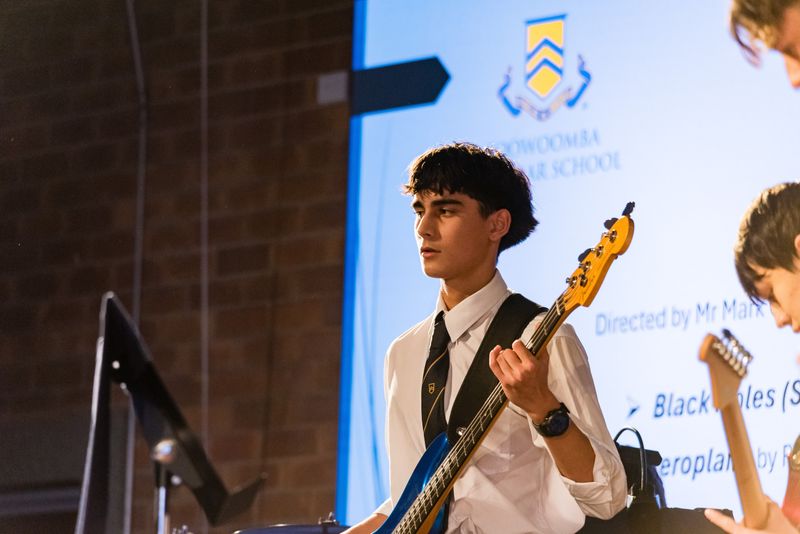
What he has in fact achieved is a level of proficiency that is easy to overlook unless you understand what it takes.
Henry has completed AMEB Grade 8 in both clarinet and bass guitar. It is a significant benchmark, usually reached after many years of consistent practice. To achieve that level on one instrument before graduating high school is impressive, but to do it on two, while balancing everything else, is very rare.
That time extends beyond the School. Henry has been selected in both the State Honours Ensemble Program (SHEP) and the Australian Honours Ensemble Program (AHEP), highly competitive programs that require a formal audition process.
“It’s good fun as you’re all there for the same reason,” he adds.
Henry feels the same way about the GPS Music Showcase and the Toowoomba Eisteddfod, explaining that it becomes more of a reunion than a competition.
Alongside his musical commitments, Henry represents the School in swimming, cross country and track and field; earning selection in GPS teams means a full schedule.
“I try to stay organised,” he says. “Sport in the afternoon, music in the morning or on weekends. It’s just about fitting it in.”

Music, though, remains a constant. Sometimes structured and demanding, sometimes something quieter.
“Sometimes I’ll just pick up the guitar and play,” he says. “That’s when it’s relaxing.”
He is also formalising his skills by studying at a tertiary level for a Diploma of Music while still at the School, which opens the door to teaching and sharing what he has learned.
It is a quiet, consistent approach. One that reflects both his humility and his exceptional musical ability. His advice to anyone thinking about taking up music is simple: “There’s just so many other opportunities that you can unlock from it.”
Henry is a gifted young musician, a dedicated sportsman and a capable, high-achieving student, a fine example of what it means to be a Toowoomba Grammar School boy, setting a standard that speaks for itself.
Latest Blog
The Power of Gratitude
“What do you say mate?” your mum nudges you as the waitress hands you your dinosaur nuggets. “Thank you.” You have always been told to use good manners, and to say thank you, but what does thank you actually mean? Is it just two meaningless words uttered with monotonous regularity, or is it a tool that can alleviate mental health issues generating happiness and a sense of wellbeing? Gratitude is the sunlight that lights up those dark days. The ability to be grateful is at the core of personal…
The Silent Epidemic: Unveiling the Consequences of Sleep Deprivation
“Sleep that soothes away all our worries. Sleep that puts each day to rest. Sleep that relieves the weary laborer and heals hurt minds.” William Shakespeare (Macbeth, 1606) Heart Disease, Cancer, and Alzheimer's. Three life-threatening diseases. Three diseases all linked to lack of sleep. According to Dr. Okorie from the children’s health division of Stanford University, “7 out of 10 high school students are falling short of… (sleep) on school nights.” The Bulk of American teens are not getting…
Tik Tok - From Fun to Fear
Social media platforms have ingrained themselves into our daily lives in a time when technology is constantly evolving and drawing millions of users with seductive features and never-ending streams of captivating content. Among these, TikTok has become a worldwide phenomenon, captivating users with its viral challenges and short-form films. Underneath the fun and inventiveness however, there is growing concern about the risks connected to TikTok and other social media platforms. TikTok's…
Active Procrastination – Unlocking the Gates of Time
“Procrastination is like a credit card: it’s a lot of fun until you get the bill.” - Christopher Parker – professional actor. Unfortunately, procrastination is a term that we are all familiar with as students; the vast majority of us have experienced it firsthand. It saps our time and results like a parasite, a burden on its host. However, despite it’s reputation, recent studies have shown that when harnessed correctly, procrastination can be a powerful tool to improve both academic efficiency…
It Takes a Village...
The Toowoomba Grammar School Boarding community plays a pivotal role in shaping the young minds of our boarders and instilling values whilst creating a sense of mateship that can last a lifetime. The nurturing and supportive network of staff not only ensure a safe and structured environment but also cultivates a sense of belonging and camaraderie among the boys. ‘The staff supply the fuel to the ship but ultimately it is the boys who steer it and decide upon its final destination’. Our TGS…
Unlocking Literacy - The Big Six Elements for Your Child’s Reading Success
Literacy skills are a core component of each day for our students, and parents often ask how they can support this from home. I am delighted to share with our parent community the essential components that underpin successful reading development. These elements, known as the Big Six, provide a solid foundation for your son’s literacy journey. These critical building blocks include: Oral Language: Communication skills are the bedrock of reading. Encourage rich conversations with your child.…
The Journey of a Boarding Mother
When you look up mother in the dictionary it reads: female parent of a child. When you look up boarder, it simply reads: a child who lives away from home. So, put “boarder mother” together and we have: the female parent of a child who lives away from home – if only it were that simple. My definition of boarding mother is: a strong, dedicated unbelievably great female parent of a child who has the wisdom to put her son’s educational needs, wellbeing and lifelong endeavours before her own. A…
The Importance of Differentiation
As parents, we all want our children to have the best possible education, and one of the most effective ways for teachers to provide this is through differentiation. Differentiation means tailoring instruction to meet the unique needs and interests of each student, and it can take many forms. First, let's define differentiation. Differentiation is a teaching approach that recognises that students have different strengths, interests, and learning styles. By adjusting instruction to meet these…
Addressing Anger in Teenage Boys
As a community dedicated to the growth and well-being of our teenage boys, it is essential to address the complexities of emotions we experience during adolescence. Among these emotions, anger stands out as a powerful and intense feeling that can influence their behaviour, relationships and overall wellbeing. Untreated anger can lead to a myriad of problems and challenges for our young boys. In this comprehensive guide, we will explore the dangers of untreated anger, ways to support healthy…


