“They also develop academic resilience as they observe that their applied efforts make a difference to their results over time.”

How does the Junior School cater for curious and eager young minds?
Children are naturally curious about their world and always eager to explore. Harnessing that energy and enthusiasm is key for us in the Junior School. We want our boys to expand their knowledge base and approach learning with a passion that will set them up for the Senior School and beyond.
First, let’s clarify some terms: extension and enrichment.
Extension is curriculum-focused; it’s where a student’s knowledge, understanding and skills are advanced. Students feel a sense of “stretch” and are encouraged to challenge themselves.
Enrichment is where a student expands their interest areas, their breadth of understanding and their ability to apply skills and knowledge more broadly.
Extension advances, enrichment broadens.
In the Junior School, students’ capacities are extended through quality classroom teaching practice of the curriculum each day. Extension is led by an expert classroom teacher who uses their deep knowledge of the subject and understanding of their students’ needs to guide more advanced and complex learning experiences. The core purpose of extension is to deepen students’ understanding by engaging them with higher-order thinking tasks and sophisticated applications of the curriculum. These activities challenge students within the framework of the curriculum, ensuring that their learning is rigorous, relevant and appropriately challenging.
Students are extended in the Junior School through the Promoting Literacy Development (PLD) program for spelling and reading, the Talk For Writing program specifically targeting writing structures and language conventions, and the Explicit Maths program for mathematical concepts and fluency. Teachers use these programs to meet students at their level of need, then advance their knowledge and skills further so each student feels that sense of “stretch” in their learning. The Diverse Learning Team supports class teachers to deliver targeted programs for boys across the cohort and track their assessment data over time to review the effectiveness of the programs. The results are impressive; when boys see the progress that they are making, their confidence grows.
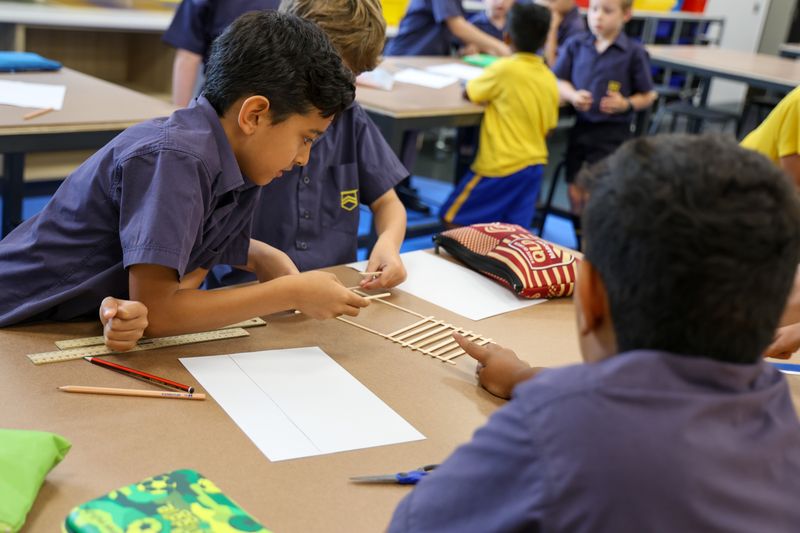
Enrichment goes beyond the formal curriculum. Its goal is to provide students with additional opportunities for intellectual, cultural, physical and personal development. Enrichment activities often take the form of co-curricular programs, after-school activities, competitions or educational excursions. These experiences broaden students’ horizons, cultivate a love of learning and allow them to pursue their interests in more diverse and creative ways.
“In the Junior School, the range of enrichment opportunities is extensive.”
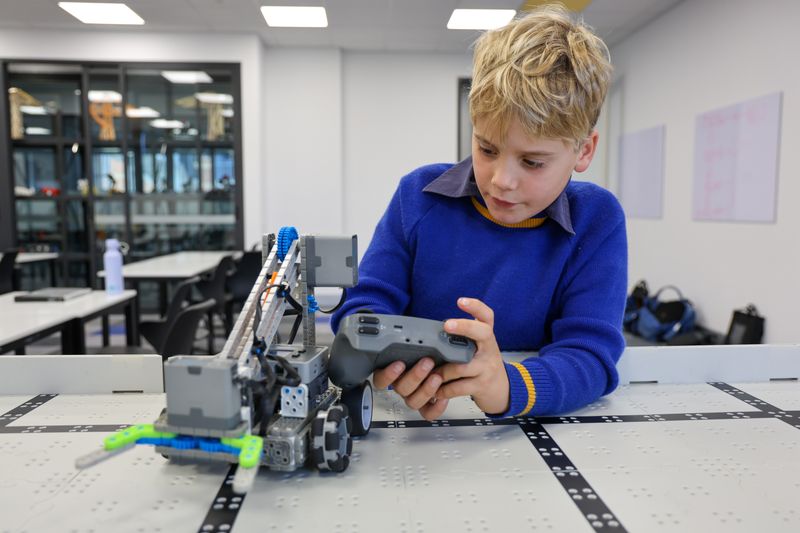
All students access the sport, music and performing arts co-curricular programs, which in themselves are hugely diverse across the year. Academic groups and competitions like chess, debating, Readers Cup, Maths Olympiad, ICAS and the DaVinci Decathlon all foster higher-order thinking and teamwork to represent the School through academic pursuits. After school activities like robotics, entrepreneurship, TGX, MasterChef, Lego engineering, art and woodwork, literacy and numeracy enrichment encourage boys to explore a new interest or go deeper into an area of passion.

With the opening of the Design, Engineering and Technology Centre, the Junior School has a dedicated Makerspace facility for classes to build, create and explore learning opportunities. Students utilise the digital and design technology curriculum integrated with humanities and science subject areas to apply their learning to real-world scenarios. The boys enjoy bringing their learning to life with relevant activities that teach them how to use design-thinking frameworks. Together, they step through a process of:
- Discovering — new learnings
- Defining — a particular topic or problem
- Developing — creating, composing and building
- Delivering — presenting or sharing their learning
Extension and enrichment are complementary, promoting student learning as enjoyable and challenging pursuits to be valued. Both serve a distinct purpose, but combined, their effect creates a learning environment where all students are both encouraged and inspired to reach their full potential. By engaging students with both depth and breadth of learning experience inside and outside of the classroom, we cultivate learners who are not only knowledgeable but also innovative, resilient and well-rounded individuals.

Want to know more?
The best way to understand the value of a TGS education is to see the School in action via a Personalised Tour.
Book Your TourLatest Blog
2024 IBSC Conference
It is part of our Strategic Plan's People Pillar which is "build a high-performing culture that supports the wellbeing and development of staff, who exemplify the TGS values and share our commitment to the growth of our boys". In fact, that focus was acknowledged in our receiving The Educator’s 2024 5-Star Employer of Choice award. The Award acknowledges excellence in providing professional development opportunities and nurturing a culture of inclusion and respect. So it was with great pleasure…
Filmmaker, Storyteller and Visionary
From his days as a boarding student at Toowoomba Grammar School, where he first dipped his toes into the world of filming GPS sporting events, to his current roles as sports documentarian and founder of the Outback Film Club, Clancy’s journey is a testament to the power of passion and perseverance. Establishing Outback Film Club has been a real triumph The echoes of school war cries reverberating around the Chandler Aquatic Centre in 2011 marked the start of Clancy’s cinematic journey.…
A Cut Shot Above The Rest
Ben’s sport takes him to the best beaches on the planet, but his love of volleyball began back at Toowoomba Grammar School, inspired after seeing his older brother play. As Ben explains, he was hooked:
Gummingurru Excursion - Deep Time History of Australia on our Doorstep
Gummingurru is unique in being the best-preserved initiation site in southeast Queensland, including bora rings and various stone arrangements that have ancient links to the totems and kinship practices of the Jarowair and Giabal people of Toowoomba and the Darling Downs, as well as the broader region within the highly significant cultural landscape of the Bunya Mountains. The boys were welcomed to, and guided through, the site and its learning centre by Mr Shannon Bauwens, a Western Wakka…
Responding to Negative Peer Interactions
As we approach the end of Term 3, we find it is typically a time when boys start to get tired and emotional and are most likely to make poor decisions that can lead to relationship challenges between peers. Comments and humour shared between mates that may have been received without concern in the first week of the term may change as boys start to tire and their tolerance levels decrease. This may lead to boys reacting with heightened and overly emotional responses. This is normal as boys are…
Remembering James Russell McWilliam AO
Jim McWilliam was a pioneering agricultural scientist and the first Director of the Australian Centre for International Agricultural Research (1982–89), where he built lasting partnerships between Australian researchers and developing countries. James Russell McWilliam AO Born near Leyburn, Queensland, Jim studied forestry at the University of Queensland and in the US, completing a PhD at Yale. He worked with the Queensland Forestry Service, CSIRO and later as Professor of Agronomy at the…
Boarding is who we are
Our boarders make up nearly one third of our student cohort from Years 5 to 12, which enables us to consider the boarding experience in all that we do at the School. Every boarding experience at TGS is about equipping boys with the skills to function as a student and preparing them for their future.
Making a Positive Impact with Homework Assistance
The Anglicare Homework Assistance Program (HAP), run in conjunction with Darling Heights State School, sees many of our boys volunteer their time on Wednesdays after class to help many young refugee and primary school students facing challenging times with their homework, or to chat and play games. Our boys thoroughly enjoy meeting, supporting and learning about the lives of the younger children. This forges community connections and fosters inclusion for the Darling Heights students; it also…
Fresh Faces Guide - TGS Sportsmen into the Fray
With their dedication to excellence and player development, TGS athletes are in good hands as they navigate the challenges and triumphs of competitive sports.


