“If you enjoy it, you’re more willing to put in the time.”— Henry Giese, Year 11
From a compulsory music lesson in Year 4, Henry Geise has gone on to complete Australian Music Examinations Board (AMEB) Grade 8 in both clarinet and bass guitar.
When Henry Geise first picked up the clarinet in Year 4, playing an instrument was compulsory at his primary school; he simply gave it a go.
What followed has been shaped less by a single decision and more by years of steady commitment.
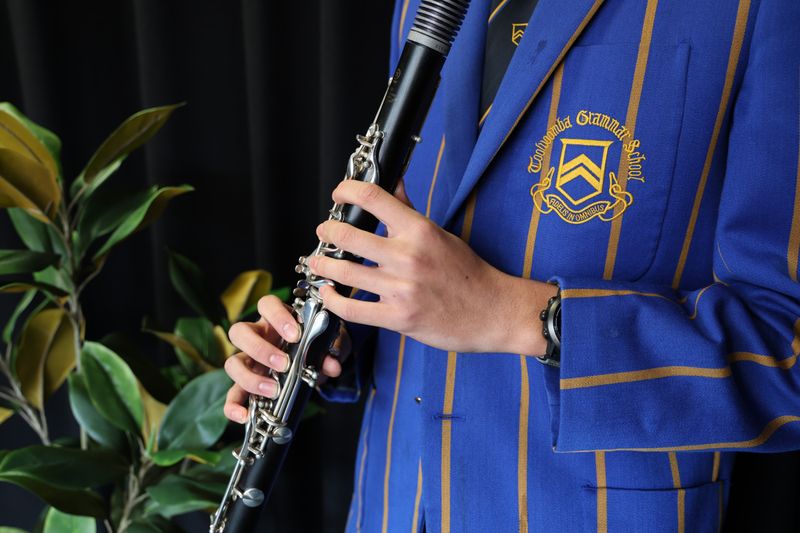
He started on clarinet and bass guitar at the same time, and those two instruments have remained his favourites despite trying piano and picking up acoustic guitar more recently.
“I would have been about eight,” he says.
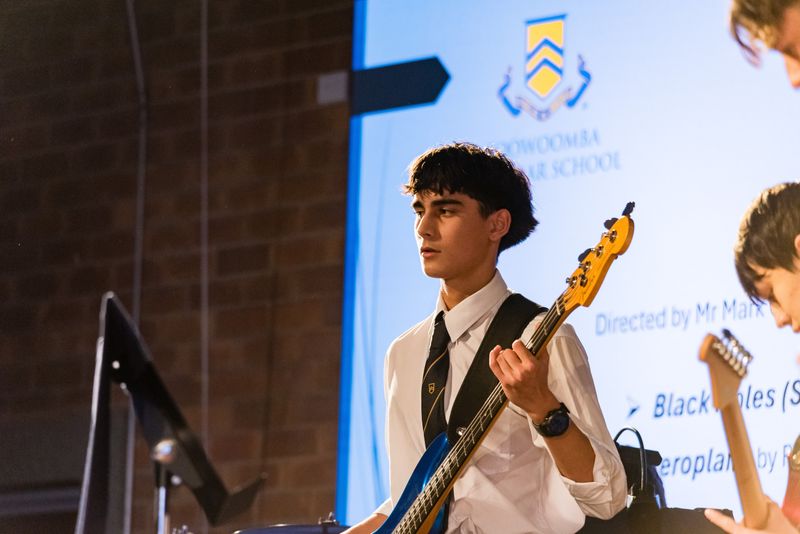
Now in Year 11, Henry is a central part of the music program; he’s part of the Big Band, Concert Band, RnB Band and Guitar Ensemble, where he is the ensemble leader.
What he has in fact achieved is a level of proficiency that is easy to overlook unless you understand what it takes.
Henry has completed AMEB Grade 8 in both clarinet and bass guitar. It is a significant benchmark, usually reached after many years of consistent practice. To achieve that level on one instrument before graduating high school is impressive, but to do it on two, while balancing everything else, is very rare.
That time extends beyond the School. Henry has been selected in both the State Honours Ensemble Program (SHEP) and the Australian Honours Ensemble Program (AHEP), highly competitive programs that require a formal audition process.
“It’s good fun as you’re all there for the same reason,” he adds.
Henry feels the same way about the GPS Music Showcase and the Toowoomba Eisteddfod, explaining that it becomes more of a reunion than a competition.
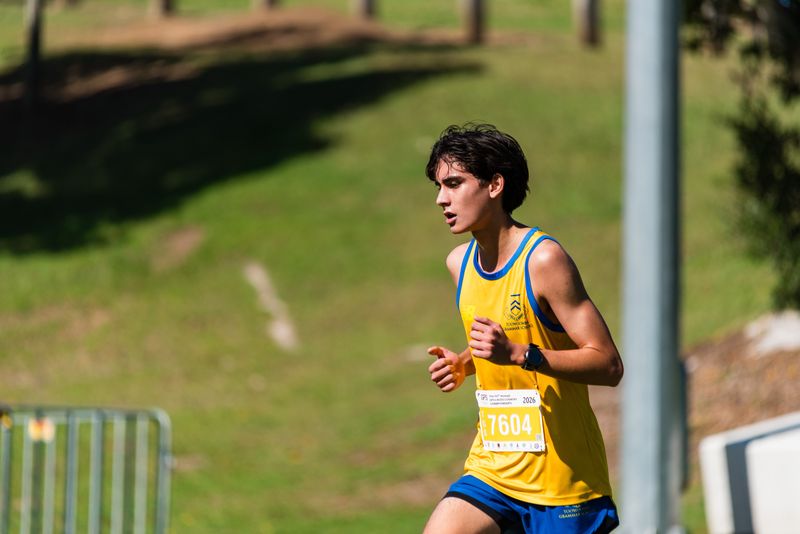
Alongside his musical commitments, Henry represents the School in swimming, cross country and track and field; earning selection in GPS teams means a full schedule.
“I try to stay organised,” he says. “Sport in the afternoon, music in the morning or on weekends. It’s just about fitting it in.”
Music, though, remains a constant. Sometimes structured and demanding, sometimes something quieter.
“Sometimes I’ll just pick up the guitar and play,” he says. “That’s when it’s relaxing.”
He is also formalising his skills by studying at a tertiary level for a Diploma of Music while still at the School, which opens the door to teaching and sharing what he has learned.
It is a quiet, consistent approach. One that reflects both his humility and his exceptional musical ability. His advice to anyone thinking about taking up music is simple: “There’s just so many other opportunities that you can unlock from it.”
Henry is a gifted young musician, a dedicated sportsman and a capable, high-achieving student, a fine example of what it means to be a Toowoomba Grammar School boy, setting a standard that speaks for itself.
Latest Blog
2024 IBSC Conference
It is part of our Strategic Plan's People Pillar which is "build a high-performing culture that supports the wellbeing and development of staff, who exemplify the TGS values and share our commitment to the growth of our boys". In fact, that focus was acknowledged in our receiving The Educator’s 2024 5-Star Employer of Choice award. The Award acknowledges excellence in providing professional development opportunities and nurturing a culture of inclusion and respect. So it was with great pleasure…
Filmmaker, Storyteller and Visionary
From his days as a boarding student at Toowoomba Grammar School, where he first dipped his toes into the world of filming GPS sporting events, to his current roles as sports documentarian and founder of the Outback Film Club, Clancy’s journey is a testament to the power of passion and perseverance. Establishing Outback Film Club has been a real triumph The echoes of school war cries reverberating around the Chandler Aquatic Centre in 2011 marked the start of Clancy’s cinematic journey.…
A Cut Shot Above The Rest
Ben’s sport takes him to the best beaches on the planet, but his love of volleyball began back at Toowoomba Grammar School, inspired after seeing his older brother play. As Ben explains, he was hooked:
Gummingurru Excursion - Deep Time History of Australia on our Doorstep
Gummingurru is unique in being the best-preserved initiation site in southeast Queensland, including bora rings and various stone arrangements that have ancient links to the totems and kinship practices of the Jarowair and Giabal people of Toowoomba and the Darling Downs, as well as the broader region within the highly significant cultural landscape of the Bunya Mountains. The boys were welcomed to, and guided through, the site and its learning centre by Mr Shannon Bauwens, a Western Wakka…
Responding to Negative Peer Interactions
As we approach the end of Term 3, we find it is typically a time when boys start to get tired and emotional and are most likely to make poor decisions that can lead to relationship challenges between peers. Comments and humour shared between mates that may have been received without concern in the first week of the term may change as boys start to tire and their tolerance levels decrease. This may lead to boys reacting with heightened and overly emotional responses. This is normal as boys are…
Remembering James Russell McWilliam AO
Jim McWilliam was a pioneering agricultural scientist and the first Director of the Australian Centre for International Agricultural Research (1982–89), where he built lasting partnerships between Australian researchers and developing countries. James Russell McWilliam AO Born near Leyburn, Queensland, Jim studied forestry at the University of Queensland and in the US, completing a PhD at Yale. He worked with the Queensland Forestry Service, CSIRO and later as Professor of Agronomy at the…
Boarding is who we are
Our boarders make up nearly one third of our student cohort from Years 5 to 12, which enables us to consider the boarding experience in all that we do at the School. Every boarding experience at TGS is about equipping boys with the skills to function as a student and preparing them for their future.
Making a Positive Impact with Homework Assistance
The Anglicare Homework Assistance Program (HAP), run in conjunction with Darling Heights State School, sees many of our boys volunteer their time on Wednesdays after class to help many young refugee and primary school students facing challenging times with their homework, or to chat and play games. Our boys thoroughly enjoy meeting, supporting and learning about the lives of the younger children. This forges community connections and fosters inclusion for the Darling Heights students; it also…
Fresh Faces Guide - TGS Sportsmen into the Fray
With their dedication to excellence and player development, TGS athletes are in good hands as they navigate the challenges and triumphs of competitive sports.


