“They also develop academic resilience as they observe that their applied efforts make a difference to their results over time.”

How does the Junior School cater for curious and eager young minds?
Children are naturally curious about their world and always eager to explore. Harnessing that energy and enthusiasm is key for us in the Junior School. We want our boys to expand their knowledge base and approach learning with a passion that will set them up for the Senior School and beyond.
First, let’s clarify some terms: extension and enrichment.
Extension is curriculum-focused; it’s where a student’s knowledge, understanding and skills are advanced. Students feel a sense of “stretch” and are encouraged to challenge themselves.
Enrichment is where a student expands their interest areas, their breadth of understanding and their ability to apply skills and knowledge more broadly.
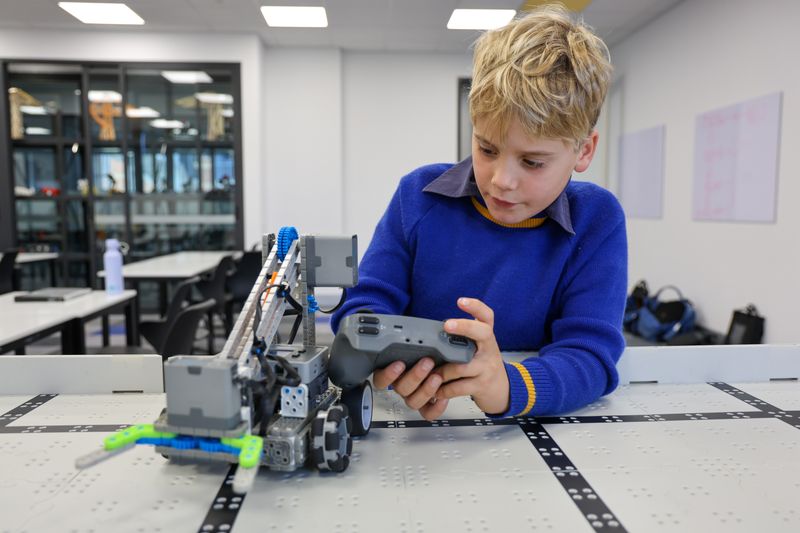
Extension advances, enrichment broadens.
In the Junior School, students’ capacities are extended through quality classroom teaching practice of the curriculum each day. Extension is led by an expert classroom teacher who uses their deep knowledge of the subject and understanding of their students’ needs to guide more advanced and complex learning experiences. The core purpose of extension is to deepen students’ understanding by engaging them with higher-order thinking tasks and sophisticated applications of the curriculum. These activities challenge students within the framework of the curriculum, ensuring that their learning is rigorous, relevant and appropriately challenging.
Students are extended in the Junior School through the Promoting Literacy Development (PLD) program for spelling and reading, the Talk For Writing program specifically targeting writing structures and language conventions, and the Explicit Maths program for mathematical concepts and fluency. Teachers use these programs to meet students at their level of need, then advance their knowledge and skills further so each student feels that sense of “stretch” in their learning. The Diverse Learning Team supports class teachers to deliver targeted programs for boys across the cohort and track their assessment data over time to review the effectiveness of the programs. The results are impressive; when boys see the progress that they are making, their confidence grows.
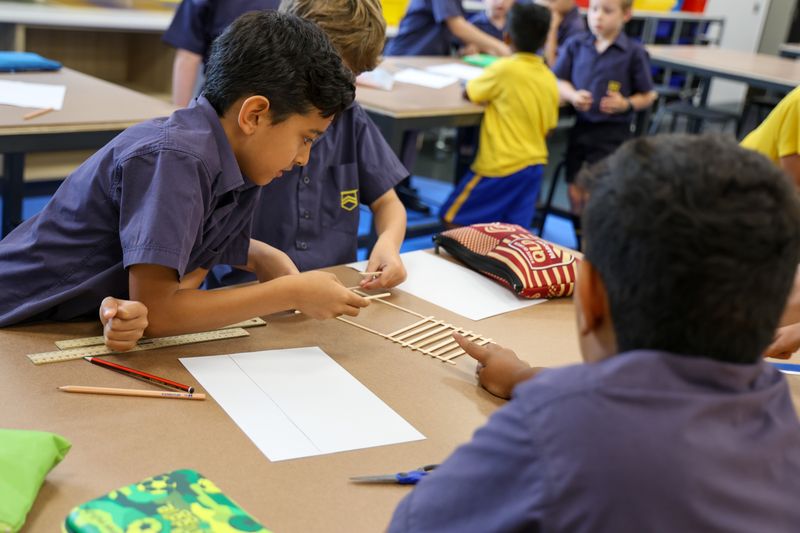
Enrichment goes beyond the formal curriculum. Its goal is to provide students with additional opportunities for intellectual, cultural, physical and personal development. Enrichment activities often take the form of co-curricular programs, after-school activities, competitions or educational excursions. These experiences broaden students’ horizons, cultivate a love of learning and allow them to pursue their interests in more diverse and creative ways.
“In the Junior School, the range of enrichment opportunities is extensive.”
All students access the sport, music and performing arts co-curricular programs, which in themselves are hugely diverse across the year. Academic groups and competitions like chess, debating, Readers Cup, Maths Olympiad, ICAS and the DaVinci Decathlon all foster higher-order thinking and teamwork to represent the School through academic pursuits. After school activities like robotics, entrepreneurship, TGX, MasterChef, Lego engineering, art and woodwork, literacy and numeracy enrichment encourage boys to explore a new interest or go deeper into an area of passion.

With the opening of the Design, Engineering and Technology Centre, the Junior School has a dedicated Makerspace facility for classes to build, create and explore learning opportunities. Students utilise the digital and design technology curriculum integrated with humanities and science subject areas to apply their learning to real-world scenarios. The boys enjoy bringing their learning to life with relevant activities that teach them how to use design-thinking frameworks. Together, they step through a process of:
- Discovering — new learnings
- Defining — a particular topic or problem
- Developing — creating, composing and building
- Delivering — presenting or sharing their learning
Extension and enrichment are complementary, promoting student learning as enjoyable and challenging pursuits to be valued. Both serve a distinct purpose, but combined, their effect creates a learning environment where all students are both encouraged and inspired to reach their full potential. By engaging students with both depth and breadth of learning experience inside and outside of the classroom, we cultivate learners who are not only knowledgeable but also innovative, resilient and well-rounded individuals.

Want to know more?
The best way to understand the value of a TGS education is to see the School in action via a Personalised Tour.
Book Your TourLatest Blog
Study Skills Program
Just as teachers benefit from an understanding of the Learning Sciences in their lesson planning and preparation, so to do students when they are studying for major summative assessments. A survey of TGS students in Years 9 to 12 found that 70% of our boys felt that they knew how to study, with the biggest impediments to study being lack of motivation and too many distractions. The most highly preferred study technique was found to be rewriting notes. Cramming, rereading the text and rewriting…
Developing Teachers Worldwide
I recently had the pleasure of attending the 2023 International Boys’ Schools Coalition (IBSC) Annual Conference at Westlake Boys High School in Auckland, New Zealand, in my capacity as a Team Leader in the IBSC Action Research Program. Action research is a systematic inquiry conducted by teachers in their own classroom to better understand the impact that an aspect of their practice is having on their students. Each year, 40 teachers from IBSC member schools from around the world are accepted…
Developing a Sense of Belonging for our TGS Boarders
How do we adequately develop a teenager’s 'sense of belonging' in boarding? Head of Boyce House, Boarding, Mr Michael Hall has investigated how 'Maslow's Hierarchy of Needs' applies to boarding. It is a psychological theory that suggests human beings have a set of fundamental needs that must be fulfilled in a hierarchical order. The theory proposes that individuals must first satisfy their physiological needs before moving on to higher-level needs, such as the 'belongingness' that is so…
Kia Moemoeā – Dream Beyond Limits
A 12-year study has found that boys consistently perform better in an all boys’ school compared to boys in co-educational schools. This was one of several interesting topics presented at the recent International Boys’ Schools Coalition (IBSC) Conference in Auckland, New Zealand which I attended alongside three of my Toowoomba Grammar School colleagues – Mr Luke Rawle, Mr Dave Klan and Mrs Jessica Galbraith. We joined 600 leading educators from 15 countries around the world for the four-day…
Blue and Gold in the Blood
“I had such fond memories from the School and enjoyed all the opportunities available, particularly participating in sport and learning at such a high level; my sons were going to have the same great education,” said Chris adamantly. Chris was a boarder from Dalby and an “all-rounder” as a student. He was part of the 1st XV, a CUO in the Cadets, a member of the debating team, involved in drama (featuring in two plays during his time) and a good academic student. “I really enjoyed boarding,”…
The Benefits of Repeated Reading
An effective and evidence-based method that can significantly improve your child's reading abilities is repeated reading. Reading proficiency is a vital skill that sets the foundation for academic success and lifelong learning. Repeated reading, a simple yet powerful technique, has been proven to enhance reading fluency, comprehension, and overall confidence. Let's delve into why repeated reading is such a beneficial practice for your child. Research consistently supports the benefits of…
Print v Digital
I recently read an article by Petra Stock, entitled "Streaming Stories: Will Children’s Digital Book Platforms Upend Print", an interesting discussion comparing ebooks and print media and the ways they are being used during and post COVID. Which is better according to the article? Well, there is a clear winner; however, like many things, the answer can depend on the situation. I'd like to break elements of the article down, along with my own thoughts and compare the two. Social…
Striking a Balance
We understand that, as parents, we aspire to provide our children with the best education and opportunities for growth. Within the Junior School at Toowoomba Grammar School, we believe in fostering a love for learning while enabling your son to reach his full potential. In this article, we would like to emphasise the significance of automaticity and basic skill practice in extending your child's learning journey, while emphasising the importance of respecting their individual pace. Automaticity…
Developing Sportsmanship from Prep
Overwhelming pride in wearing the Blue and Gold is a familiar emotion for Toowoomba Grammar School students, as is abundantly evident in all our boys, from Prep to Year 12. This emotion and passion for the School is the essence of our TGS culture and defines what it means to be a TGS student. The launch of the 2022 - 2026 Strategic Plan creates an exciting opportunity for our co-curricular program, which links perfectly into the "character and wellbeing" pillar. The development of good…


