“They also develop academic resilience as they observe that their applied efforts make a difference to their results over time.”

How does the Junior School cater for curious and eager young minds?
Children are naturally curious about their world and always eager to explore. Harnessing that energy and enthusiasm is key for us in the Junior School. We want our boys to expand their knowledge base and approach learning with a passion that will set them up for the Senior School and beyond.
First, let’s clarify some terms: extension and enrichment.
Extension is curriculum-focused; it’s where a student’s knowledge, understanding and skills are advanced. Students feel a sense of “stretch” and are encouraged to challenge themselves.
Enrichment is where a student expands their interest areas, their breadth of understanding and their ability to apply skills and knowledge more broadly.
Extension advances, enrichment broadens.
In the Junior School, students’ capacities are extended through quality classroom teaching practice of the curriculum each day. Extension is led by an expert classroom teacher who uses their deep knowledge of the subject and understanding of their students’ needs to guide more advanced and complex learning experiences. The core purpose of extension is to deepen students’ understanding by engaging them with higher-order thinking tasks and sophisticated applications of the curriculum. These activities challenge students within the framework of the curriculum, ensuring that their learning is rigorous, relevant and appropriately challenging.
Students are extended in the Junior School through the Promoting Literacy Development (PLD) program for spelling and reading, the Talk For Writing program specifically targeting writing structures and language conventions, and the Explicit Maths program for mathematical concepts and fluency. Teachers use these programs to meet students at their level of need, then advance their knowledge and skills further so each student feels that sense of “stretch” in their learning. The Diverse Learning Team supports class teachers to deliver targeted programs for boys across the cohort and track their assessment data over time to review the effectiveness of the programs. The results are impressive; when boys see the progress that they are making, their confidence grows.
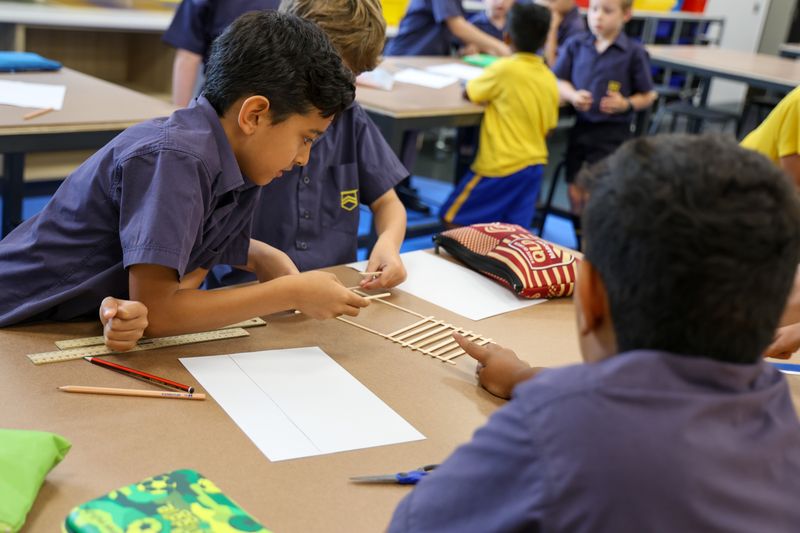
Enrichment goes beyond the formal curriculum. Its goal is to provide students with additional opportunities for intellectual, cultural, physical and personal development. Enrichment activities often take the form of co-curricular programs, after-school activities, competitions or educational excursions. These experiences broaden students’ horizons, cultivate a love of learning and allow them to pursue their interests in more diverse and creative ways.
“In the Junior School, the range of enrichment opportunities is extensive.”
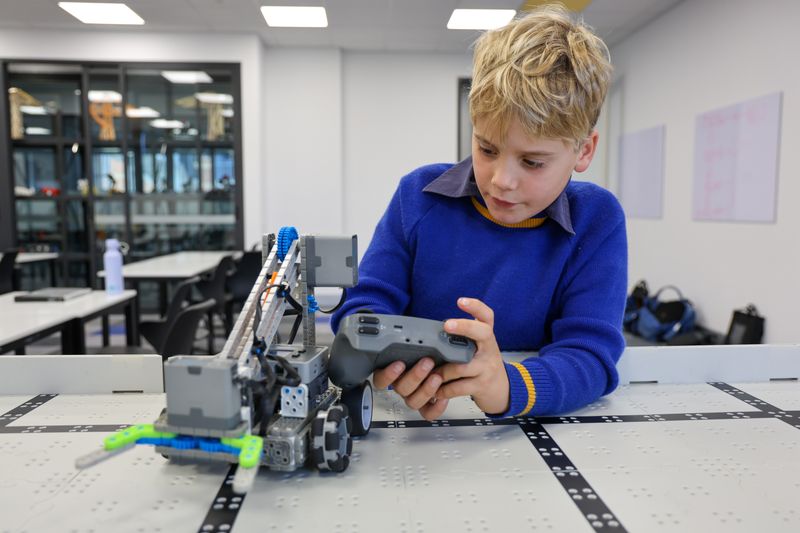
All students access the sport, music and performing arts co-curricular programs, which in themselves are hugely diverse across the year. Academic groups and competitions like chess, debating, Readers Cup, Maths Olympiad, ICAS and the DaVinci Decathlon all foster higher-order thinking and teamwork to represent the School through academic pursuits. After school activities like robotics, entrepreneurship, TGX, MasterChef, Lego engineering, art and woodwork, literacy and numeracy enrichment encourage boys to explore a new interest or go deeper into an area of passion.

With the opening of the Design, Engineering and Technology Centre, the Junior School has a dedicated Makerspace facility for classes to build, create and explore learning opportunities. Students utilise the digital and design technology curriculum integrated with humanities and science subject areas to apply their learning to real-world scenarios. The boys enjoy bringing their learning to life with relevant activities that teach them how to use design-thinking frameworks. Together, they step through a process of:
- Discovering — new learnings
- Defining — a particular topic or problem
- Developing — creating, composing and building
- Delivering — presenting or sharing their learning
Extension and enrichment are complementary, promoting student learning as enjoyable and challenging pursuits to be valued. Both serve a distinct purpose, but combined, their effect creates a learning environment where all students are both encouraged and inspired to reach their full potential. By engaging students with both depth and breadth of learning experience inside and outside of the classroom, we cultivate learners who are not only knowledgeable but also innovative, resilient and well-rounded individuals.

Want to know more?
The best way to understand the value of a TGS education is to see the School in action via a Personalised Tour.
Book Your TourLatest Blog
The Grammar Boy: TGS Character Cast in Bronze for All Time
Unveiled on Friday, 7 November 2025, this new statue is more than a work of art. It is a symbol of the enduring character that has shaped Toowoomba Grammar School for 150 years. The ceremony began with the ringing of the School House bell, it’s a sound many current students were hearing for the first time but one that may just have stirred memories for some of the Old Boys in attendance. As Headmaster Dr John Kinniburgh remarked in his address, “Today is a special occasion… one I’ve been…
Taking TGS Rugby West: making mates in the Longreach district
Last month, Head of Rugby Lincoln Clapham, TGS Old Boys' Association Vice President, Trent Raymond (1989-93) and two Year 11 boarding students, Luke Burrow (2025 First XV Co-captain) and Archie Smart, travelled 11.5 hours west to Longreach to deliver rugby clinics in partnership with the Longreach School of Distance Education (LSODE) and Western Queensland Rugby Union. Archie and Luke had both been to Longreach before but enjoyed the QANTAS Founders Museum The visit was part of a broader…
The Modified Rugby Program’s Game-Changing Impact
Founded in Brisbane in 2014 by the not-for-profit GingerCloud Foundation Limited, the Modified Rugby Program (MRP) gives neurodiverse young people the chance to play a sport and their families the opportunity to be part of a sporting community. It also allows coaches and player mentors the very privileged role of helping these young people have what many consider a normal experience - the joy of being part of a team. For Year 12 boarder Will Brown, it is a cause that is close to his heart.…
When School days become years of Mateship, Growth and Unforgettable Memories
Yesterday’s Awards Assembly for our senior cohort saw lashings of pride, reflection and a time for parents and caregivers to savour the very nearness of graduation after years of growth and grit. As the boys prepare for their final external exams and the much-anticipated Formal, this gathering marked the beginning of their final chapter at Toowoomba Grammar School. The assembly featured a moving reel that traced their growth from wide-eyed Junior School boys to confident young men. There were…
Japan: A Journey of Discovery, Culture and Connection
For 30 students and four staff members from Toowoomba Grammar School, the recent Japan Cultural and Technology Tour was a vibrant tapestry of tradition, innovation and transformation. From the bustling streets of Tokyo to the serene temples of Kyoto, this immersive experience offered students a unique lens through which to view the world. The Kinkaku-ji (Golden Pavilion)
TGS Puts Boys’ Online Safety First with Global EdTech Honour
This year, Toowoomba Grammar School was honoured at the Global EdTech Awards, becoming the only Australian school to receive recognition in this category of the prestigious international program. While the category - Best Network Manager - may not often make headlines, it celebrates the quiet achievers who empower learning, protect students and enable innovation. Arthur C. Clarke once said, “Any sufficiently advanced technology is indistinguishable from magic.” If that’s true, then network…
Ompelliargo - Episode 2 - School House: A Gothic Revival at the Heart of TGS
School House in 1907 Constructed in 1875, School House is more than just a structure - it’s a symbol of the community’s commitment to education and a cornerstone of the School’s heritage. Designed by Toowoomba architect Willoughby Powell and built by local craftsman John William Garget, the building reflects the Gothic Revival style, a design language that blends classical proportions with pointed arches, intricate fretwork and a sense of grandeur. Heritage architect Ms Stephanie Keays, a…
The Power of Character and Connection Every Day
As we mark R U OK? Day, it’s a timely reminder of the importance of looking out for one another and staying connected. Whilst today is a National Day of Action, the message is clear: asking “R U OK?” should not be reserved for just one day of the year. By having regular, meaningful conversations with each other, we create trust and normalise talking about what’s really going on in our lives. This simple but powerful practice ensures that when someone is struggling, they know they have a…
Managing Conflict with Pre-Teens and Teenagers
Understanding the developmental challenges of our boys, particularly in managing emotional resilience and independence, helps parents navigate these moments more effectively. Conflict is a natural and inevitable part of adolescence, and for parents of preteens and teenagers at Toowoomba Grammar School, managing these moments effectively is key to nurturing their emotional growth and maintaining a healthy relationship.


